
Many wonder how to detox estrogen naturally in order to maintain a healthy estrogen balance. Your body’s ability to detox estrogen makes a big impact on your reproductive and overall health and wellness.
Estrogen detoxification (or estrogen detox for short) is the biochemical process of breaking down and removing excess estrogen from the body. And while this process happens daily without our conscious awareness, there are certainly diet and lifestyle changes that can help to support its function.
In this article, we will cover why estrogen detoxification is so important to health and wellness and how you can use diet and lifestyle to help support your body’s innate ability to get rid of extra estrogen.
Let’s get started!
What is estrogen
Before we get too far into how to detox estrogen naturally, we should first cover what estrogen is and its main roles in the human body.
Estrogen is often considered the queen bee of the female sex hormones because of its role in sexual maturation, ovulation, and preparing the body for a pregnancy.
Aside from its role in reproduction, estrogen is also important for bone, heart, and skin health. Its wide reaching effects even impact mood and brain health.
There are 3 main forms of estrogen:
- Estrone (E1): This form is mostly produced after menopause.
- Estradiol (E2): This is the most potent and prevalent form of estrogen that is produced during reproductive years.
- Estriol (E3): This is the form that is made predominantly by the placenta during pregnancy.
This article will focus on the detoxification of estradiol, or E2 since this is the form of estrogen that is more prevalent for most of a woman’s reproductive life.
Now, I also need to mention one last form of estrogen, xenoestrogens. Xenoestrogens are exogenous (meaning, not made in the body) estrogen-like substances that can mimic the function of estrogen in the body. These substances are labeled endocrine disrupting chemicals since they interfere with the normal hormonal signaling in the body.
Our liver has the job of detoxing both endogenous and xenoestrogens alike. But because the burden of doing so can be quite taxing, reducing exposure to xenoestrogens is an important strategy for promoting healthy estrogen detoxification. You can read more about how to reduce xenoestrogen exposure in this article.
Why is estrogen detox important
While estradiol has many helpful and important health impacts, issues with estrogen detoxification and therefore estrogen balance can lead to some negative health effects.
One of the most common issues with poor estrogen detox is estrogen dominance. This is an imbalance in estrogen levels that leads to symptoms such as irregular or heavy periods, weight gain, breast tenderness, and more.
Estrogen dominance can appear for various reasons, but a common cause is poor estrogen detoxification.
This is because the estrogen detoxification process is what tags and eliminates unnecessary estrogens from circulation. If this system is not working efficiently, it allows for a build up of estrogens that were tagged for excretion.
Another concern with poor estrogen detoxification is an increased risk of certain types of cancer. Inefficient detoxification can lead to the formation of harmful estrogen metabolites that damage DNA. This is believed to set off a cascade that leads to the initiation of cancer (1).
Phases of estrogen detox
As you can see, being able to detox estrogen naturally is important not only for feeling your best, but also for managing long term health by reducing cancer risk.
By the end of this article, you’ll have an idea of what diet and lifestyle changes can help to support healthy estrogen detoxification. But first, let’s cover the process of estrogen detoxification more specifically.
Phase 1: Hydroxylation
In phase 1 of estrogen detoxification, estrogen is converted from a fat soluble molecule to a water soluble molecule. This is done through the addition of a hydroxyl group via 3 separate pathways.
- 2-OH Pathway: The most protective pathway and creates the least reactive/ harmful intermediate.
- 4-OH Pathway: This pathway creates the most reactive intermediates that are most likely to damage DNA and increase the risk of certain types of cancer.
- 16-OH Pathway: The intermediates created in this pathway have some benefits to bone health but may also produce uncomfortable estrogen dominance symptoms.
In ideal circumstances, the 2-OH pathway should be predominantly used because it creates the least harmful intermediates. While the 4-OH and 16-OH pathways are minimized.
Phase 2: Conjugation
In phase 2, the potentially harmful intermediates created in phase 1 of estrogen detoxification are neutralized into compounds that are safe for excretion.
There are three main processes that occur in phase 2 of estrogen detoxification:
- Methylation: The addition of a methyl group.
- Glucuronidation: The addition of glucuronic acid.
- Sulfation: The addition of a sulfur group.
And you guessed it, there are many nutritional cofactors that are necessary to efficiently run phase 2 of estrogen detoxification. Some examples include vitamin B6, vitamin B12, folate, magnesium, and sulfur rich compounds such as sulforaphane.
Phase 3: Elimination
After conjugation in phase 2, the estrogen metabolites are safe to be eliminated from the body. The estrogen metabolites are released from the liver and head to the gut and/or the kidney for excretion in stool and urine.
Interestingly, certain forms of gut bacteria produce an enzyme called beta glucuronidase. This enzyme has the ability to bring some estrogen tagged for elimination in the stool back into circulation.
As you can imagine, this is more likely to occur in situations with slow bowel transit because the enzyme has more opportunity to work on more estrogen. Healthy and regular bowel movements are one of the most important things you can optimize to help support natural estrogen detox.
And with those 3 simple steps, we’ve completed estrogen detox!
How to support healthy estrogen detox naturally
So, now that we understand how healthy estrogen detox is supposed to work, let’s talk about what we can do to make sure this whole 3-step process happens like it should.
Each of these 3 steps require certain nutrients to make sure the process moves along swiftly. By providing our body with these essential nutrients, we support estrogen detox naturally.
Here are some key steps to help support healthy estrogen detoxification.
1. Eat plenty of cruciferous veggies
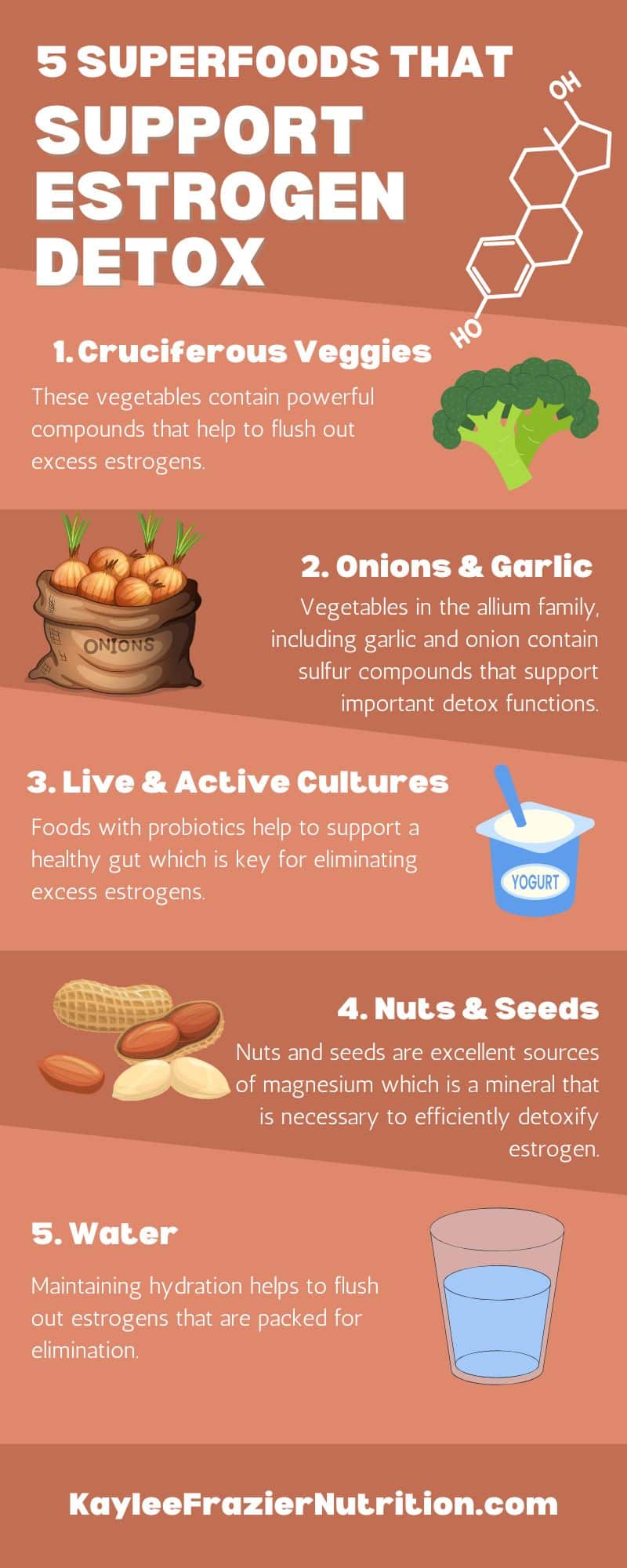
Cruciferous vegetables, such as broccoli, cauliflower, and Brussels sprouts contain glucosinolates and indole-3-carbinol which help to push estrogen down the beneficial 2-OH pathway during phase 1 of estrogen detoxification.
Additionally, these sulfur containing compounds that are found in cruciferous veggies are required for stage 2 of estrogen detoxification.
2. Include veggies from the allium family
Much like the cruciferous vegetables mentioned above, vegetables from the allium family also contain many sulfur containing compounds. The unique flavor and smell of onion, garlic, and leeks are thanks to these beneficial sulfur compounds.
Aside from giving you bad breath, these sulfur compounds are crucially important for stage 2 of estrogen detoxification. The sulfur-containing compounds are added on to the estrogen intermediate in preparation for excretion from the body.
3. Make sure to get enough B-vitamins
Several B-vitamins are crucial for phase 2 enzyme activity. You’ll want to be sure you are getting enough folate, choline, vitamin B6, and vitamin B12. These vitamins all power methylation that is necessary for phase 2 of detoxification.
- Folate: leafy greens, legumes, beef liver
- Choline: egg yolks, beef liver
- Vitamin B6: meat, fish, eggs, beef liver
- Vitamin B12: meat, dairy, beef liver
4. Eat foods rich in magnesium
Magnesium helps to run many processes in the body, but is specifically important for methylation and sulfation in phase 2 of estrogen detoxification.
Foods that are exceptionally high in magnesium include:
- Pumpkin seeds
- Chia seeds
- Almonds, cashews, peanuts
Considering that most women do not eat sufficient magnesium on a daily basis, you may consider the addition of a magnesium supplement. Speak with your health provider about starting on a magnesium supplement. I typically recommend magnesium glycinate as it is well tolerated and highly bioavailable.
5. Load up on fiber rich foods
Your poop is the final stop for estrogen before being eliminated. Regular bowel movements ensure that the estrogen that’s been tagged for elimination are actually being eliminated, rather than reabsorbed by the work of beta glucuronidase.
Eating plenty of fiber helps to keep your bowels active. Aim to eat about 25 grams of fiber per day. This means loading up on veggies, legumes, whole grains, and high fiber fruits.
6. Include foods with live and active cultures
Another great way to keep your gut healthy and happy is by eating foods with live and active cultures – also known as probiotics!
Probiotics help to maintain a healthy balance of gut microbes. And this is important so you don’t end up with too many of the types of bacteria that make the enzyme beta glucuronidase.
As you can recall from prior in this article, beta glucuronidase can unpackage estrogen tagged for elimination and get them back into circulation. Which isn’t ideal when we are trying to keep estrogen levels balanced.
Trying to eat foods with live and active cultures daily! This includes yogurt, cottage cheese, kefir, kombucha, kimchi, and raw sauerkraut.
7. Drink plenty of water
And lastly, we can’t forget to mention the importance of drinking plenty of water. Maintaining good hydration helps with phase 3 of estrogen detoxification in two ways.
First, water helps to keep your stool soft. And like we’ve already mentioned, regular bowel movements are paramount for healthy estrogen levels.
And second, estrogen is also excreted through the kidneys in the urine. Drinking enough water helps to flush out excess estrogens packaged for removal through the urine.
Wondering how much water you need to drink? A good rule of thumb is to drink enough water so your urine remains a light lemonade color and you need to use the restroom every 2-3 hours. The amount of water it takes to achieve this is different for everyone and can even vary from day to day!
Signs your estrogen detox pathways are struggling
After reading all this, you might be wondering how your estrogen pathways are doing? There are a few ways to assess how well you are detoxing estrogen.
First, you can make inferences based on symptoms. Common symptoms of estrogen dominance are a good sign that your estrogen levels aren’t balanced.
Symptoms such as heavy/ painful periods, breast tenderness, bloating, and headaches are common in cases with estrogen excess. Some women also experience difficulty concentrating and losing weight.
While using symptoms to infer estrogen status is fast, easy, and cheap, it isn’t as precise as knowing exactly where your estrogen levels fall. The DUTCH test is a comprehensive at home test that can help you understand exactly where your hormone levels are falling. The results of the DUTCH test can help you develop a detailed plan of care to help you balance your overall hormone health – including estrogen dominance.
Wrapping it all up
There are so many ways you can help to detox estrogen naturally in order to support healthy hormone balance. Eating a balanced diet with plenty of rich color, fiber, and probiotics are just a few of the key steps towards hormone balance.
If you are looking for more support on your health journey, I’d love to help! Check out my scheduling page for more information on how you can work with me one on one.